
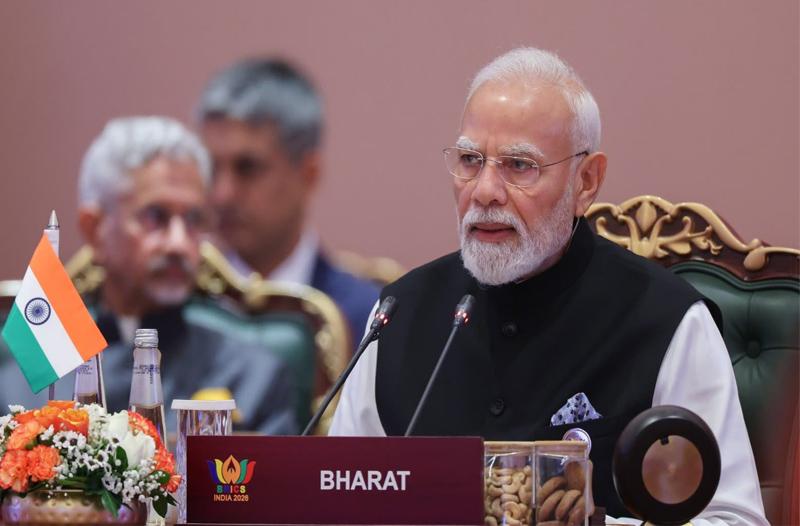
Prime Minister Narendra Modi has called for the Global South to move from being a 'rule-taker' to a 'rule-shaper', stressing the need for greater representation of developing countries in global decision-making, the Ministry of External Affairs (MEA) said in a statement on Sunday (September 13).
Must turn the 'pyramid of privilege' into 'platform of partnership'
Addressing the session on 'Inclusive Global Governance and Strengthening Multilateralism' at the 18th BRICS Summit in New Delhi on Saturday, PM Modi said the Global South often finds itself 'in the front row of global crises, but in the back row of decision-making'. He called for transforming the existing 'pyramid of privilege' into a 'platform of partnership'.
"Global South is at the front row of global crises, but the back row of decision-making. We must turn the 'pyramid of privilege' into a 'platform of partnership'," he said.
PM Modi further emphasised that global governance must reflect present-day realities and called for greater representation of the Global South, particularly in institutions such as the United Nations Security Council.
"Efforts must be made to make the Global South move from being a rule-taker to a rule-shaper. Through BRICS, we can provide young diplomats and policymakers from the Global South with negotiation skills, practical training and legal expertise," he said.
Prime Minister Narendra Modi also highlighted the contribution of seafarers to global trade, noting that they often lack adequate support during times of crisis. He proposed the establishment of a Seafarers Emergency Support Network to provide assistance to seafarers during emergencies.
Concluding his remarks, PM Modi said that since the future of nations is shared, the right to shape that future must also be shared. He called for a shift 'from voice to impact' and 'from privilege to partnership'.
The session concluded with the adoption of the New Delhi BRICS Leaders' Declaration, setting the shared priorities, commitment, and direction for BRICS cooperation going forward.
The declaration expressed deep concern over the continued escalation of tensions in West Asia and called for exercising maximum restraint, as well as avoiding actions that could further aggravate the situation.
What is Global South?
The Global South is a political and economic term mostly used for developing and emerging countries across Asia, Africa, Latin America and the Caribbean. It is not a defined geographical category: Countries in the Global South can be located in the Northern Hemisphere as well. The term broadly reflects differences in wealth, development, historical experience and influence in global institutions rather than simply location on a map.
Notably, it also does not mean that all these countries share the same political system, foreign policy or economic interests. India, China, Brazil, Indonesia, South Africa, Saudi Arabia and Egypt, for example, have very different priorities. What brings many of them together is a shared interest in having greater influence over decisions that affect the global economy and international governance.
Why does the Global South matter?
The economic weight of developing countries has changed dramatically. According to UN Trade and Development (UNCTAD), the Global South accounts for 42% of world GDP, 44% of merchandise exports and 65% of foreign direct investment inflows in 2023. The most prominent argument for its greater representation is that the growing economic weight has not always translated into comparable influence in institutions created in a very different era.
Behind the Global South's push for reform lies the fact that the global economy has changed, but the structures governing it have not changed at the same pace. So, the demand naturally goes beyond getting more seats around the table. Developing countries want a greater say in setting the rules themselves.