
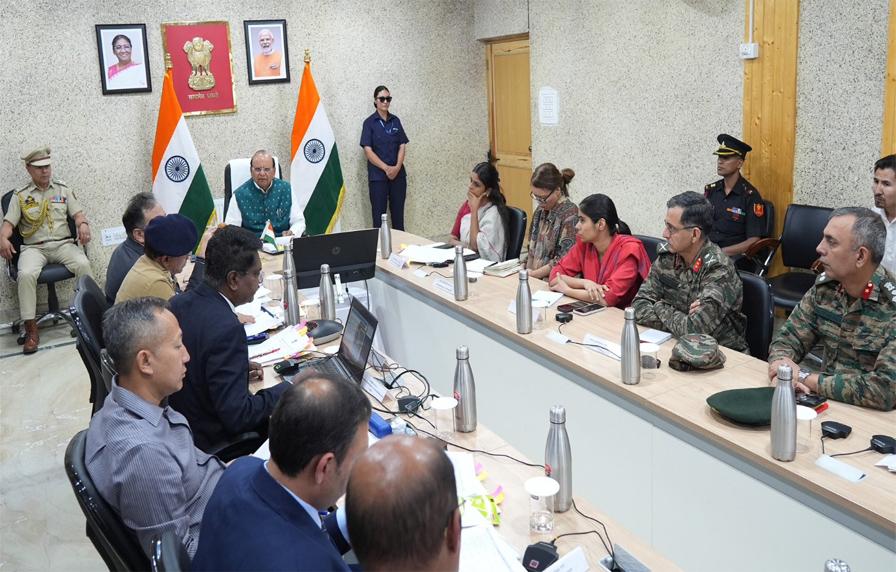
The Ladakh State Board for Wildlife has rejected a sub-committee report on settling boundaries within protected areas, citing discrepancies, as LG Vinai Kumar Saxena directed authorities to resolve the rights and claims of local communities in these areas within two months, an official said on Saturday.Chairing the 16th meeting of the newly constituted Ladakh State Board for Wildlife, the LG said settling the rights and claims of local communities in the Hemis National Park, High Altitude Cold Desert (Changthang) Wildlife Sanctuary and Karakoram (Nubra–Shyok) Wildlife Sanctuary within two months would pave the way for a lawful and participatory process to finalise their boundaries, particularly in the newly created districts.
A key agenda of the Board meeting was the consideration of the sub-committee report on finalisation of the boundaries of these three protected wildlife areas, a spokesperson of the Lok Bhavan said. The sub-committee, under the supervision of the chief secretary, was formed in January to identify and delineate core wildlife areas while excluding Army settlements and essential habitations.
The spokesperson said the decision is expected to bring long-awaited certainty to local communities, who have been seeking clarity regarding the boundaries of the protected areas and recognition of their longstanding settlements, habitations and traditional rights.
The local people contend that settlements and human habitations have existed for a very long time in these areas, which clearly fall outside the purview of the wildlife sanctuary. However, the sub-committee had included all these areas in its report.
The erstwhile Jammu and Kashmir government had issued a preliminary notification of the boundaries of these sanctuaries in 1987. However, the Board, while deliberating threadbare on the final notification of the three protected areas, noted that the notification had not correctly mapped the boundaries of the protected areas on the ground, the spokesperson said.
Saxena, during the Board meeting, observed that the statutory process prescribed under the Wildlife (Protection) Act, 1972, for settlement of rights of individuals and communities residing in the proposed protected areas, has not been undertaken by the Committee.
He noted that this process was not initiated and that the delineation of boundaries was carried out through a table-top exercise, without adherence to the legal framework.
This rendered the exercise inconsistent with the provisions of the Act, inequitable to affected communities, and susceptible to legal challenges, the spokesperson said.He said the Board observed that several of the areas, included in the sub-committee report, are of strategic importance and relate to national security, and the mandatory defence considerations were not duly factored in the report of the subcommittee.
Saxena also observed that the international boundaries, as depicted in the Survey of India maps, have not been taken as a reference point, which is essential while determining the limits of any protected area, the spokesperson said.
Accordingly, taking a serious note of the discrepancies, the LG directed to set aside the report of the sub-committee.The Board also directed the designated deputy commissioners and settlement officers to resume the process of public hearings and to complete the proceedings within a period of two months.Saxena urged the people to come forth with their claims and titles of land and traditional rights, including those on pasture lands, to enable the administration to arrive at a fair decision on the boundaries of these protected areas.
The Board noted that an early completion of the settlement process would be of great significance to local communities, as it would bring greater clarity, certainty and recognition to their bona fide rights in these protected areas.
At the same time, it would also provide a clearer framework for wildlife conservation and development activities, within these landscapes, the spokesperson said.
He said the Board also ratified 23 important projects and sent them to the Standing Committee of the National Board of Wildlife, Government of India, for clearance.
These included proposals relating to power transmission infrastructure in strategically important border areas, defence infrastructure and other essential projects in the Karakoram and Changthang regions, the spokesperson said.