

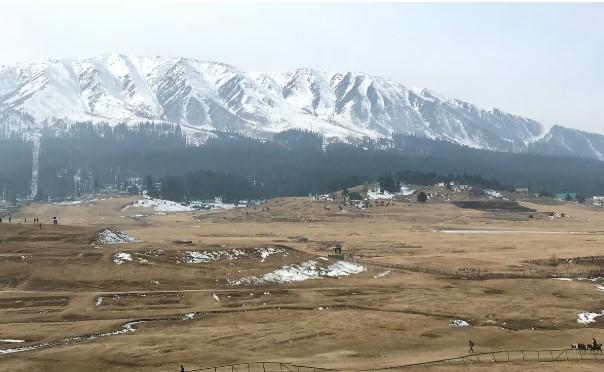
After experiencing an unusually warm winter, Kashmir is now witnessing below-normal daytime temperatures due to recent rains and snowfall, which could augur well for crops and flowering plants, officials said on Friday.
Since Sunday, most parts of the valley have seen intermittent rains, while many areas at higher elevations received snowfall.There was overnight snowfall in tourist resorts like Gulmarg and Sonamarg, as well as in various locations in the upper reaches of Kashmir. As a result, the mountains and hills in the valley are now covered with fresh, pristine layers of snow, officials noted.
The wet weather has caused a drop in daytime temperatures across Kashmir. Over the past few days, the valley has been experiencing colder days and warmer nights due to cloud cover.
On Thursday, Srinagar city recorded a maximum temperature of 9.5 degrees Celsius, which is over six degrees below the normal of 16 degrees. The maximum temperature on that day was reported to be 3-7 degrees lower than the seasonal average. However, the minimum temperature was approximately two degrees above normal, officials informed.
These lower daytime temperatures mark a departure from the unusually high temperatures seen in the valley in recent weeks. This winter brought a significant rainfall deficit, with Jammu and Kashmir recording its seventh consecutive winter rainfall deficit.
The core winter period from December 2025 to February 2026 ended with a remarkable 65 per cent shortfall from the normal, receiving just 100.6 mm of precipitation compared to the normal of 284.9 mm.
December’s actual rainfall was 13.0 mm versus a normal of 59.4 mm, resulting in a departure of 78 per cent. In January, the area received 73.4 mm against a normal of 95.1 mm, reflecting a 23 per cent shortfall.
Although some Western Disturbance activity in January prevented a total collapse of the season’s rainfall, overall precipitation remained below normal and could not compensate for December’s deficit.
February’s actual rainfall was only 14.2 mm compared to a normal of 130.4 mm, leading to an 89 per cent shortfall and unusually warm conditions with temperatures frequently exceeding normal levels by more than 10 degrees.
In the early weeks of March, daytime temperatures also remained several degrees above normal. For the first time in history, the famous ski resort of Gulmarg recorded a high of 17.2 degrees Celsius in the first week of March, which is 13.7 degrees above normal. The all-time high for March at the resort is 18 degrees Celsius.
However, due to the recent wet weather, daytime temperatures have decreased and are currently below normal. Experts believe this weather is better suited for the plants, as the warmer temperatures have led to an early spring bloom in some species.
Sameera Qayoom, an agrometeorologist at the Sher-e-Kashmir University of Agricultural Sciences and Technology (SKUAST), stated, “Wherever there has been no flowering so far, the current weather is favourable. The lower temperatures will delay bud burst and promote more normal flowering.” Qayoom noted that there has not been much flowering or pollination yet, so the rains are unlikely to have a significant negative impact, such as flower drop. “There won’t be a huge impact from the rains, but if temperatures continue to decrease, it could delay pollination and harm the flowers,” she said.
She emphasised that while this winter has seen abnormal weather patterns, temperatures are expected to stabilise and return to normal.
The warm temperatures this year have accelerated the blooming of tulips, leading to the early opening of the famous Tulip Garden in Kashmir. Qayoom also mentioned that rainfall could extend the lifespan of the tulips as long as temperatures remain average.
The Meteorological Department has informed that there is a possibility of intermittent light rain/snow at many places on Friday, but the weather would improve thereafter. It stated that while the weather is likely to stay generally dry from March 21 to 25, there is a chance of a brief spell of rain/snow at a few places on 23.
Between March 26 and 28, there is a possibility of light rain or snow, particularly in higher elevations, and another spell of rain or snow is likely from March 29 to 31, it said.
The MeT Office has advised farmers to resume agricultural activities after Saturday.