
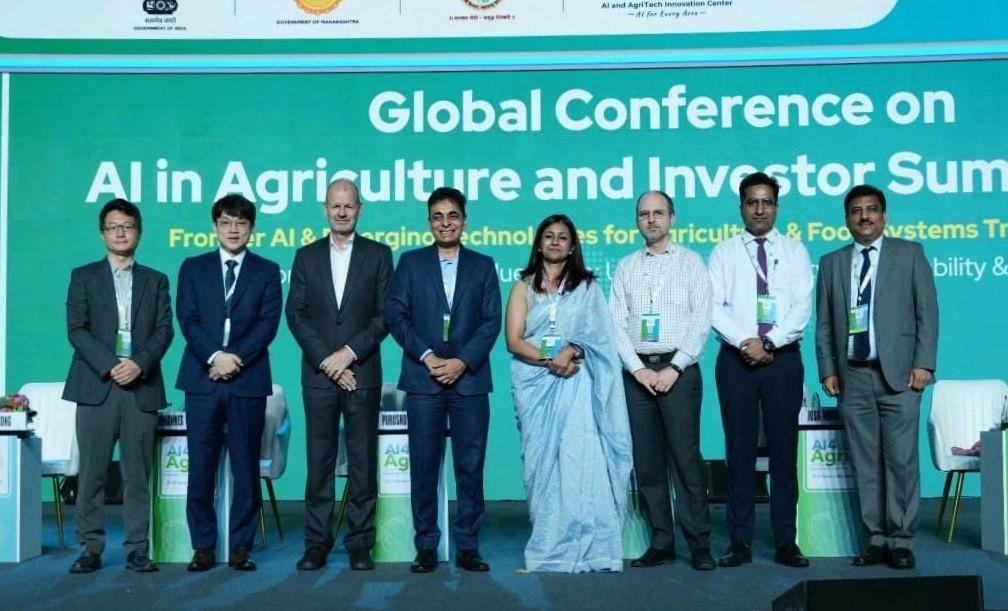
The Kisan Khidmat Ghar (KKG) ecosystem of Jammu and Kashmir garnered significant praise at the Government of Maharashtra's Global Conference on AI in Agriculture and Investor Summit (AI4Agri 2026).
Presented as a model for inclusive, AI-enabled agricultural service delivery, KKG impressed organisers and panelists with its innovative approach.
Mission Director, Holistic Agriculture Development Programme (HADP), Sandeep Kumar, participated as a panelist in the plenary session on “AI Across the Value Chain: Unlocking Inclusivity, Sustainability and Efficiency”. He highlighted how Jammu and Kashmir has embedded digital intelligence into a structured public delivery architecture, rather than treating AI as a standalone pilot.
At the centre of the presentation was the KKG ecosystem, an entrepreneur-enabled, IT-driven network of physical single-window centres at the panchayat level, designed to convert the digital services into walk-in, assisted public support for farmers. These centres provide assisted applications, advisory access, execution support and handholding, ensuring that the farmers who are not digitally fluent are not excluded from modern agri-services.
The Mission Director explained that HADP’s inclusion pathway is built as a full institutional stack, starting with Kisan Sampark Abhiyan for field mobilisation and assisted onboarding, moving through the Kisan Sathi portal as the digital backbone for registration, applications and tracking, supported by Daksh Kisan for structured skilling and stabilised through KKG handholding on the ground. This is reinforced by OTA tracking for geo- and time-stamped field verification and by Kisan Sathi 360 for a unified farmer-level view of services accessed, skilling received, advisories issued and outcomes tracked.
The panelists and delegates particularly noted the value of linking the physical facilitation centres with digital advisory and monitoring systems. They described the model as a practical pathway to ensure inclusivity while scaling technology across dispersed rural geographies.
On the technology front, the presentation also outlined how AI/ML is being positioned within this delivery stack to reduce risk and improve efficiency across the value chain. Predictive models for apple disease risks such as scab and alternaria and pest forecasting modules under validation, are integrated into the KKG digital ecosystem so that early warnings and advisories translate into preventive field action.
The Mission Director also referred to sensor-based Smart Agriculture pilots under HADP, including LoRa-enabled monitoring frameworks across agro-climatic zones and the extension of digital decision-support beyond horticulture into wider crop and livestock contexts.
The AI4Agri 2026 summit—designed to advance responsible AI adoption in agriculture and catalyse collaboration among governments, institutions and investors—provided a national and global platform for showcasing such field-grounded models.
The officials noted that the summit's appreciation underscores the growing relevance of HADP's "assisted digital governance" approach, where AI tools are delivered through physical service points, backed by skilling and verified through outcome tracking. This approach ensures technology enhances farmer decisions rather than remaining confined to dashboards.