
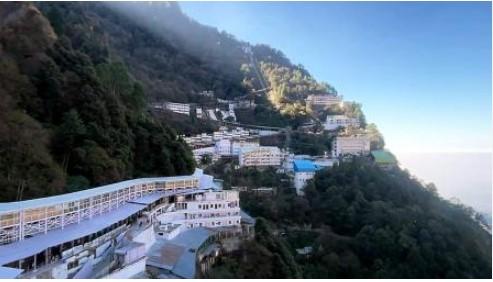
The pilgrim footfall at the Mata Vaishno Devi shrine atop Trikuta hills in Reasi district of Jammu and Kashmir fell below the 70-lakh mark in 2025, marking a significant decline as a series of security-related incidents and prolonged weather disruptions affected the annual pilgrimage, officials said.
According to officials, a total of 68.85 lakh pilgrims had paid obeisance at the shrine till December 28 this year, with around 70,000 more expected to visit in the remaining days of 2025, given the heavy influx of pilgrims in view of the New Year.
Compared to last year when annual footfall had crossed the 94.84-lakh mark, the over 27.4 per cent drop underscores the cumulative effect of security concerns and natural disruptions on religious tourism in the region, they said. The year saw multiple setbacks, with the Pahalgam terror attack in April that left 26 persons dead and prompted heightened security measures across the region.This was followed by a major counter-terror operation, Operation Sindoor, next month when the Indian armed forces hit terror infrastructure in Pakistan, leading to tensions on the border.
Adding to the challenges, a landslide triggered by incessant rain along the yatra track near Katra on August 26 resulted in the death of 35 pilgrims and caused damage to a critical stretch, forcing authorities to halt the pilgrimage for three weeks in August-September. Officials said the prolonged closure during what is traditionally considered a high-footfall period had a direct impact on the overall pilgrim footfall for the year.
“Safety of pilgrims remains the top priority. Decisions to suspend the yatra were taken based on real-time assessments of weather and track conditions,” a shrine board official said.
Despite the challenges, he said the Shri Mata Vaishno Devi Shrine Board continued infrastructure upgrades, including track maintenance, disaster preparedness measures and enhanced surveillance.
The yatra was resumed after restoration work and safety audits, with additional deployment of security forces and continuous monitoring of weather advisories, he added.
According to official data, the highest footfall was recorded in April when 9,81,228 pilgrims visited the shrine, while the lowest, 1,85,165 devotees payed obeisance at the shrine in September when the Jammu region witnessed record rainfall and flood-like conditions.
March recorded the second highest pilgrim turnout of 9,40,143 followed by June (9,26,263), July (6,77,652), January (5,69,164), August (5,33,756), November (4,23,553), May (4,13,365), October (3,84,952) and February (3,78,865). As many as 4,71,396 pilgrims visited the shrine in December till now.
From 13.95 lakh in 1986 when the shrine board took over the affairs of the shrine, there has been a steady increase in pilgrim footfall with each passing year, touching the all time high of 1.04 crore in 2012, after 1.01 crore devotees visited the site in 2011.
The pilgrim arrivals at the shrine touched 31.15 lakh in 1991 and reached 74.17 lakh in 2007.
However, the number dropped to 67.92 lakh in 2008 which was attributed to the two-month long Amarnath land row agitation, but again went up to 82 lakh in 2009 and 87.2 lakh next year (2010).
The pilgrim arrivals dropped from 93.24 lakh in 2013 to 78.03 lakh in 2014 and further to 77.76 lakh in 2015 and 77.23 lakh in 2016.
It increased to 81.78 lakhs in 2017 and 85.87 lakhs in 2018 but again dropped to 79.40 lakhs in 2019 — the year in which the Centre revoked the special status to Jammu and Kashmir under Article 370 of the Constitution, and bifurcated the erstwhile state into two Union territories.
Only 17 lakh pilgrims, the lowest in over three decades, visited the shrine in 2020 when the shrine, for the first time in its history, remained closed for five months amid the COVID-19 pandemic and reopened for the pilgrims on August 16, 2020, the data showed.
The number of pilgrims increased to 55.77 lakh next year.