
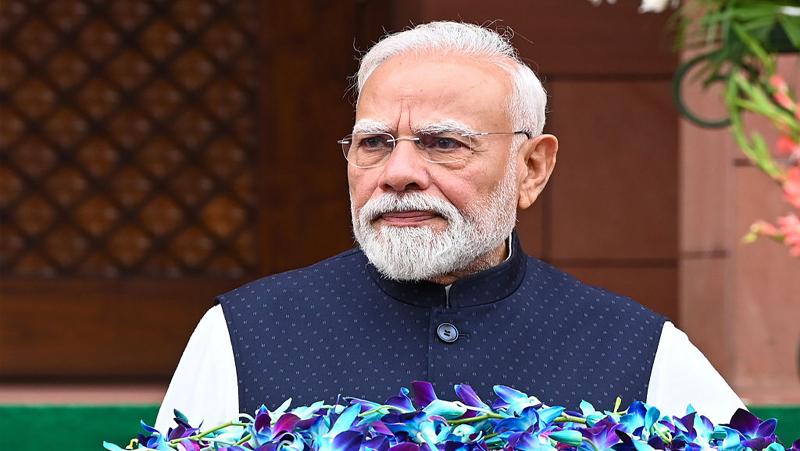
India is the mother of democracy and the people openly debate different issues and discuss different perspectives, Prime Minister Narendra Modi said on Tuesday, a day after the Delhi police’s clampdown on the protest against the Election Commission sparked international headlines, several court cases alleging police and mob brutality on protesters, Supreme Court lawyers and journalists, and an expression of concern from the UN.
“India is the mother of democracy. India has over 100 languages, around 80,000 registered newspapers and publications, and more than 1,000 satellite television channels,” the prime minister said at the Bloomberg Economic Forum.
“And that is not all. In the age of social media, India has more than 500 million YouTube users and over 500 million Instagram users.“In our country, people openly debate different issues and discuss different perspectives. And in the present era, one of the major forces that has played a significant role in this has been digital power,” Modi added.
At another point in his speech, he said: “The government has authority, but its purpose should not be to make its citizens dependent on the system. Rather, its purpose should be to strengthen and empower its citizens, and India is on this path.”
He spoke about the responsibility that comes with authority.
“Whoever possesses knowledge, wealth, and power, how they use it is crucial. The true value of power lies in its purpose, and it's crucial to understand this philosophy in today's times... Our thousands of years of tradition have taught us this, and in India, we have demonstrated its application in our governance and work culture...,” he said.
Modi said India's economic growth was anchored in strong fundamentals and a sustained reform drive.
India, he said, sought to expand its global economic influence through shared prosperity.
"We do not grow at anyone's cost. We grow with the world. And for the world," Modi said, pitching India as a reliable economic partner amid geopolitical tensions, trade disruptions and growing competition over critical technologies and resources.
The prime minister cited the country's 7.8 per cent economic growth in the April-June quarter, foreign-exchange reserves exceeding $700 billion and reforms spanning taxation, insolvency and labour laws as evidence of its resilience.
"In this world full of uncertainties, India inspires reliability and stability," he said.
He cited strong macroeconomic fundamentals, including drastic reduction in India's current account deficit from over 4 per cent 12-13 years back to about 0.5 per cent now.
Modi highlighted India's digital public infrastructure, expanding startup ecosystem and clean-energy capacity as examples of how domestic capabilities could support inclusive growth.
He said India was sharing its experience in digital identity, payments and public infrastructure with partner countries, particularly in the Global South.
"For us, reforms are not a compulsion. Reforms are our conviction," he said.Modi also warned that supply chains, energy, critical minerals, payment systems and technology were increasingly becoming instruments of geopolitical pressure, making reliable partners and resilient economic systems more important. They are all becoming tools for coercion and for exerting pressure," he said.