
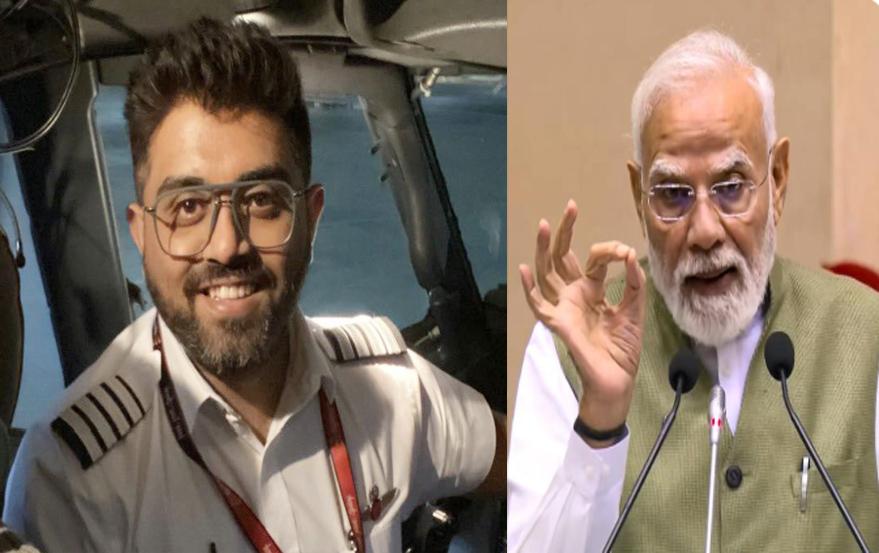
Prime Minister Narendra Modi praised Indian pilot Captain Smit Machchhar for his courage during the mid-air cockpit confrontation aboard a flydubai flight, saying his actions prevented a potential 9/11-like incident. Machchhar was injured after his co-pilot allegedly attacked him and attempted to crash the aircraft. Despite the life-threatening situation, the captain helped avert a major disaster and bring the flight to safety.
'This feat by Smit fills us with pride'
Addressing the Union Public Service Commission (UPSC) centenary celebrations at Bharat Mandapam in New Delhi, the Prime Minister said the bravery of Captain Smit Machchhar fills the nation's heart with pride. "In the incident that occurred yesterday, Captain Smit of India demonstrated remarkable patience, presence of mind, and courage; indeed, as the Prime Minister of Israel stated today, an Indian prevented a 9/11-style tragedy. This feat by Smit fills us with pride," said PM Modi.
PM Modi said he also spoke to Captain Smit's father, mother, and wife. "Today, I also spoke with his father, Bhupendra; his mother, Gita; and his wife, Sonal. He is currently undergoing treatment. Today, the entire world is proud of him,"
In his telephonic conversation with the pilot's wife and parents, Modi also stressed that Indian missions are providing all possible help to the injured pilot, who is undergoing treatment at a hospital in Saudi Arabia. During the phone conversation, the Prime Minister applauded the bravery of the pilot who saved hundreds of lives, government sources said.
The Prime Minister urged citizens to pray for Machchhar's long life and good health and to salute the pilot for bringing glory to India.
The flydubai flight FZ1073, travelling from Dubai to Tel Aviv, had transmitted emergency signals on Wednesday and made a sharp descent of more than 17,000 feet from 34,000 feet before diverting to Prince Sultan Bin Abdel Aziz Airport in Saudi Arabia's Tabuk city. The flight was carrying 174 passengers, including 27 children. In videos circulating on social media, the pilot can be seen drenched in blood, wearing an oxygen mask, and lying on his back in the galley of the aircraft.
PM Modi on 100 years of UPSC
Prime Minister Modi said that the UPSC's 100-year journey represents not only a legacy but also the aspirations of millions of young Indians and the trust placed in it by citizens. "Today marks not only the celebration of UPSC's 100-year journey but also the celebration of a legacy," PM Modi said, adding that governments, technology and examination syllabi may have changed over the years, but public trust in the institution has remained unwavering.
A commemorative postage stamp and coin marking the centenary were also released, along with a compilation of 100 significant case laws.
While visiting an exhibition at the venue, PM Modi said he recalled that Netaji Subhas Chandra Bose had appeared for the examination in 1920. He noted that despite British rule at the time, the examination included a Sanskrit paper and Bose had written the paper in Sanskrit.
He also paid tribute to Sardar Vallabhbhai Patel, crediting him with strengthening the institution and making it a key pillar of independent India. He said Patel recognised the importance of building the skills and administrative framework required for the reconstruction of the nation. "After independence, he faced not only the challenge of keeping the country free but also the challenge of steering the nation. Sardar Vallabhbhai Patel provided the necessary framework of skills for the nation's reconstruction. He established this institution as a key pillar of independent India and strengthened it. For the reconstruction of the nation, the skill framework that was needed was given by Sardar Vallabhbhai Patel. He made the institution of UPSC a major pillar of independent India," he said.
'Nation first, citizen first'
PM Modi said UPSC has an important role in providing the country with the kind of professionals required for effective governance. He said the candidates selected through the commission would play an important role in building a "Viksit Bharat". "Keeping this in mind, we must remember two principles: Nation First and Citizen First," he said.
Referring to a shift in the approach to governance, PM Modi said India has moved from an era when the government was considered the ultimate authority to one where the principle of
Nagrik Devo Bhava" guides public service.
"For us, the citizen is no less than a deity. Serving the citizen is our foremost priority," he said.
The Prime Minister said 21st-century India is adopting a new work culture based on "Pro-People, Pro-Active, Good Governance". "We need to give professionals who have the empathy to understand the pain of the poor, who can be innovative in problem-solving and understand the needs of the country. Professionals who ensure that laws are followed, but also understand whether a particular law is good for the people or not," he said.