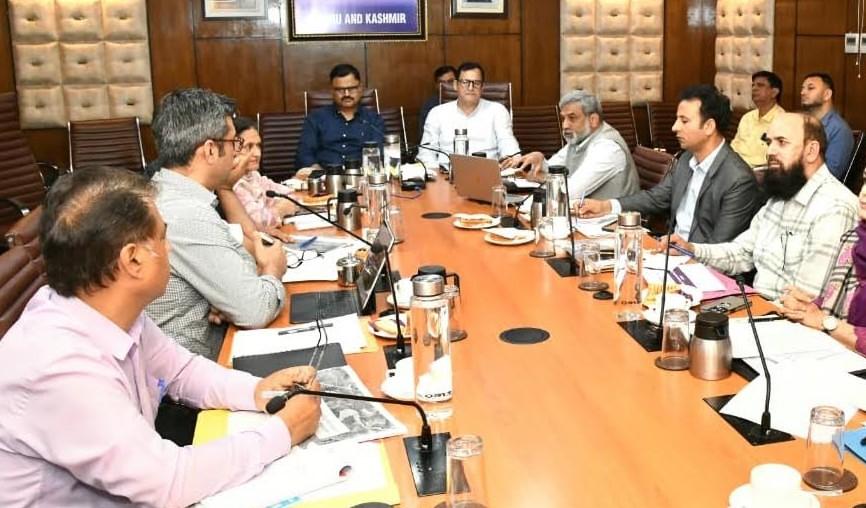

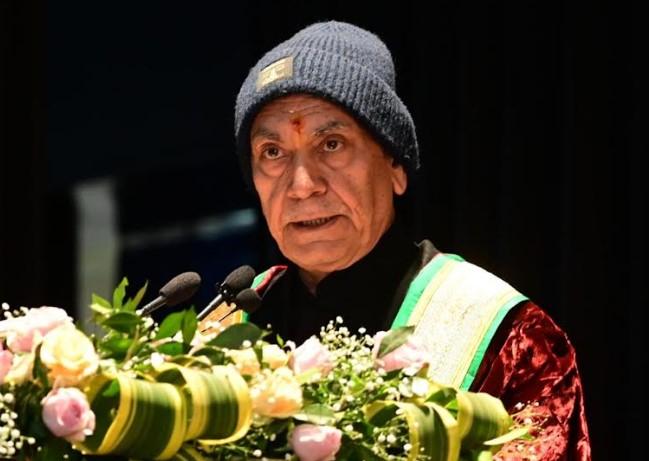
The Lieutenant Governor, Shri Manoj Sinha, graced the 11th Convocation Ceremony of Shri Mata Vaishno Devi University, today.
In his convocation address, the Lieutenant Governor spoke about the imperative of shifting from outdated, rote learning system to more modern and skill-based learning approaches to meet the demands of an evolving world.
“Our endeavour should be reduction in curriculum load and development of adaptable skills for future jobs.
Even if a single student of any higher education institution is unemployed or not setting up his or her enterprise, then it clearly means that the educational institution and its teachers have not done their work honestly,” he said.
The Lieutenant Governor called upon the students to create new paths in life, give new direction to life, explore new aspects and suggest new ways for the prosperity of the nation.
“To achieve the goal of a developed India by 2047, every student, every educational institution will have to fulfil its responsibility because the future and its development will be based on the knowledge economy,” the Lieutenant Governor said.
The Lieutenant Governor gave five solutions to keep pace with technological change and the demands of the 21st-century workforces.
“Integrate artificial intelligence into teaching, learning and university operations and adopt new technological tools on a priority basis. Shift from rote learning to a lifelong, flexible and skill-focused learning model. Develop strong partnerships with industry and other institutions. The focus must be on experiential learning. Humanities students, in particular, need to understand that in a world dominated by artificial intelligence, the importance of things that machines cannot provide will increase. Focus should be on innovation, research, and social service, cutting-edge research and to offer solutions to local problems,” the Lieutenant Governor said.
The Lieutenant Governor highlighted the responsibility of the teaching community to study and analyse the impact of rapid advancements in science, humanities, and technology on human civilization. He stressed that classroom methodologies must evolve to synchronize with these shifts, ensuring they drive both economic development and social progress.
“Classroom and our teachings must equip students to build better lives, foster inclusive development and create more enlightened society,” he said.
The Lieutenant Governor lauded Shri Mata Vaishno Devi University for its distinguished contributions to India’s educational landscape and its steadfast commitment to public welfare.
He also extended his felicitations to the women students for their exceptional academic achievements and for setting new benchmarks of excellence.
The Lieutenant Governor entrusted upon Shri Mata Vaishno Devi University to provide scientific solutions for the challenges being faced by the UT of Jammu Kashmir.
In light of recent devastating natural calamities, the Lieutenant Governor urged the university to prioritize research into advanced early-warning systems for cloudbursts, landslides, and floods. He further emphasized the importance of sustainable infrastructure, and called for dedicated research on the recycling and reuse of road and construction materials.
The Lieutenant Governor asked the Shri Mata Vaishno Devi University to redesign the courses for Dogri and Vedic studies to make these subjects more engaging and contemporary to attract more students. He also directed for formulating a comprehensive strategy for the swift completion of the languishing indoor stadium.
The Lieutenant Governor also highlighted the pivotal role of Shri Mata Vaishno Devi Shrine Board in the relief and rehabilitation of families affected by recent natural calamities. He praised the Board's ongoing commitment to cultural preservation through its support to institutions dedicated to Sanskrit and Vedic education.
He informed that the Shrine Board has procured products worth Rs 22 crore from local Self-Help Groups in Reasi and adjoining areas. The Lieutenant Governor stated that he has directed the CEO of the Shrine Board to maximize procurement from local residents to support their livelihoods.
The Lieutenant Governor further informed that the Shrine Board has undertaken the construction of the Shankaracharya Temple along with five other temples in the district, while an International Museum of the Goddess is set to be established in Katra.
“The construction of helipads at Katra and Shiv Khori is entering its final phase. I am hopeful that the devotees will be able to avail heli-services from Katra to the Shiv Khori Shrine during the upcoming Maha Shivratri”, the Lieutenant Governor said.
On the occasion, the Lieutenant Governor inaugurated 'High-End Computing AI and Deep Learning Lab' and 'Accommodation for Married Scholars'.
During the convocation, 821 degrees were awarded including 228 Masters, 26 Doctorates, and 567 Undergraduate degrees. Medals were also conferred to 25 (07 Male and 18 Female) meritorious students. A total of 10 students (04 Male and 06 Female) received Infosys Foundation Prize for Excellence, while Certificate of Distinction were awarded to 11 students.
Prof. (Dr.) Pragati Kumar, Vice-Chancellor, Shri Mata Vaishno Devi University presented the University report on the occasion.
Prof. T.G Sitharam, former Chairman, All India Council for Technical Education (AICTE); Dr. Ashok Bhan and Smt. Gunjan Rana, Members, Shri Mata Vaishno Devi Shrine Board; Shri Shantmanu, Additional Chief Secretary, Higher Education Department, Vice Chancellors of various universities, Heads of Departments, faculty and students attended the convocation ceremony.
Shri Saraf Singh Nag, Chairman, District Development Council Reasi; Shri Baldev Raj Sharma, Member of Legislative Assembly, Shri Mata Vaishno Devi; Shri Ramesh Kumar, Divisional Commissioner Jammu; Shri Bhim Sen Tuti, IGP Jammu; Shri Sachin Kumar Vaishya, CEO Shri Mata Vaishno Devi Shrine Board; Ms Nidhi Malik, Deputy Commissioner Reasi and senior officials were also present.