
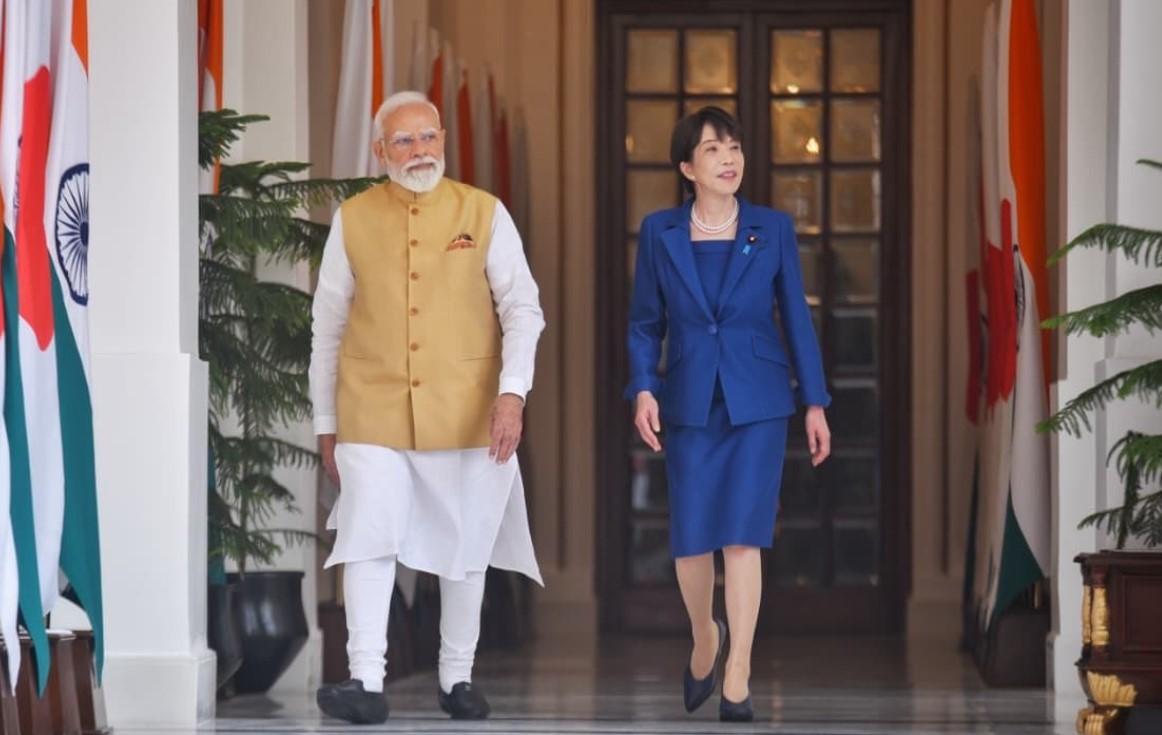
India and Japan on Thursday unveiled a series of agreements spanning artificial intelligence, economic security, critical minerals, defence, healthcare and energy, as Prime Minister Narendra Modi and his Japanese counterpart Sanae Takaichi sought to elevate one of Asia's most consequential strategic partnerships.
The agreements, announced after the 16th India-Japan Annual Summit in New Delhi, reflect growing convergence between the two countries on technology, supply-chain resilience, economic security and regional stability amid increasing global uncertainty.
Welcoming Takaichi on her first visit to India as Prime Minister, Modi highlighted the civilisational links underpinning the relationship.
"It gives me great pleasure to welcome Prime Minister Sanae Takaichi to India on her first visit for the India-Japan Annual Summit. She is Japan's first female Prime Minister and a visionary, popular leader. Moreover, she hails from Japan's Nara Prefecture, a vital centre of the shared Buddhist heritage between India and Japan," Modi said.
Technology emerged as the centrepiece of the summit, with both sides issuing a joint statement on artificial intelligence and signing agreements to deepen cooperation in the sector.
"Prime Minister Takaichi and I believe that a technology partnership will become the strongest pillar of our cooperation," Modi said.
"Several key institutions within the Indian AI ecosystem have also signed agreements with their Japanese partners today. The convergence of Japan's precision technology and India's software capabilities will impart new momentum and strength to global AI development."
The leaders also highlighted cooperation in semiconductors, quantum technologies, critical minerals, advanced manufacturing and next-generation mobility, areas increasingly viewed as critical to economic security and resilient supply chains.
The summit also marked a significant step forward in defence ties. Modi announced that India and Japan had signed an agreement for their first defence co-development project involving the Naval Radio Antenna 'Unicorn'.
"This project will open a new chapter in our defence technology partnership. We will now jointly develop defence technologies that strengthen regional peace, maritime security and the rules-based order," he said.
The two countries further expanded cooperation in pharmaceuticals, medical devices and biotechnology, with Modi saying the partnership would contribute to global health security.
"By combining India's scale with Japan's quality, we will work towards delivering affordable, reliable and advanced health solutions to the world," he said.
Economic ties featured prominently during the discussions, with Modi reiterating the shared goal of attracting 10 trillion yen in Japanese investment into India and doubling the number of Japanese companies operating in the country over the next decade.
"The India-Japan investment partnership is steadily strengthening. Over the past year, around 120 new business agreements have been concluded, which will bring over 10 billion dollars in Japanese investment to India," Modi said.
"Our goal is clear: to attract 10 trillion yen in investment from Japan to India and to double the number of Japanese companies operating in India over the next decade."
The two sides also adopted a roadmap for economic security cooperation and announced steps to strengthen energy security through the India-Japan Bio-gas Initiative, under which 1,000 biogas and organic fertiliser plants will be established across India.
Modi said the initiative would support sustainability, energy security and rural livelihoods while advancing India's clean-energy transition.
Beyond the agreements themselves, the summit underscored the strategic significance both countries attach to the Indo-Pacific.
"Today, both India and Japan are among the world's largest economies. A free, prosperous and rules-based Indo-Pacific is our shared priority," Modi said.
"As the region's largest democratic and market economies, we have undertaken several significant initiatives today. Together, these will pave the way for peace, stability and progress across the entire region."
The summit reflected the steady evolution of India-Japan ties from a partnership once centred largely on infrastructure and development assistance to one increasingly driven by technology, investment, defence cooperation, economic security and regional strategy.