

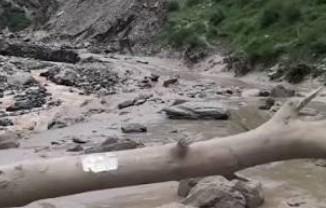
An active weather system driven by the interaction of a moisture-laden western disturbance and advancing southwest monsoon currents triggered cloudbursts, flash floods and landslides across parts of Jammu and Kashmir on Wednesday, disrupting road connectivity, inundating schools and markets, and bringing a sharp drop in temperatures after a prolonged heat spell.The worst impact was reported from the Bhalessa belt of Doda district in the Chenab Valley, where cloudbursts struck Kalalgisar and Seru villages following intense afternoon rainfall. Flash floods swept through the area, depositing large quantities of debris on roads, damaging a bridge and road infrastructure, and disrupting connectivity to several villages.
Standing crops and agricultural land also suffered damage, while authorities said restoration work would begin once weather conditions improved. No casualties were reported.
Traffic movement was briefly disrupted in Gandoh after a flash flood in a seasonal stream deposited mud and debris on the road. The route was reopened after machinery cleared the blockage.
In Udhampur district, landslides triggered by heavy rain suspended traffic on the Chenani-Latti-Dudu road for more than three hours after large boulders fell near Bup-Sarar ahead of Man Talai, cutting off Latti tehsil and Dudu subdivision. Road clearance operations later restored vehicular movement, although dozens of vehicles remained stranded on both sides during the closure.
Heavy rainfall was recorded across much of the Jammu region during the past 24 hours, with Samba receiving 62.5 mm of rain, followed by Jammu city with 35.8 mm, Kathua 23.8 mm, Rajouri 19.6 mm and Katra 12 mm.Localised downpours also triggered flash floods and landslides in parts of the Chenab Valley and the Pir Panjal region, prompting authorities to advise residents against unnecessary travel through vulnerable areas due to the heightened risk of landslides and shooting stones.
In south Kashmir, flash floods inundated Mir Mohalla in Guridraman village of the Larnoo area in Anantnag district after intense rainfall. A government primary school was flooded while classes were in progress, forcing local residents to evacuate students before water entered the building. Officials confirmed that no injuries were reported.
Police, State Disaster Response Force (SDRF) personnel, and civil administration teams reached the affected area, while an assessment of damage to the school and surrounding infrastructure was initiated.
Heavy rain also flooded parts of the Aishmuqam market and the shrine of Hazrat Zainuddin Wali (RA), while showers lashed Pahalgam and the upper reaches of Kulgam, Pulwama and Shopian districts. Rainfall was also reported from higher reaches of Budgam, Ganderbal and parts of north Kashmir, while the Valley plains remained largely overcast with intermittent rain and gusty winds.
The adverse weather also affected religious pilgrimages in the Chenab region. Authorities suspended the Machail Mata Yatra in Kishtwar and the Mindhal Mata Yatra towards Pangi in Himachal Pradesh due to continuous rainfall, slippery roads and the threat of shooting stones. Pilgrims were advised to defer travel until weather conditions improve.
The widespread rainfall brought significant relief from the intense heat that had gripped Kashmir over the previous five days. Srinagar’s maximum temperature dropped to 31.5 degrees Celsius after recording 35.5 degrees on Monday and 35.3 degrees on Tuesday.
The Meteorological Department said the southwest monsoon has advanced into most parts of Jammu and Kashmir and Ladakh, covering the entire meteorological subdivision a day later than the normal onset date of June 30.
The department has forecast widespread light to moderate rain and thundershowers across Jammu and Kashmir through July 5, with heavy rainfall, brief intense showers, thunderstorms, gusty winds and isolated hailstorms likely at a few places. It has warned that intense rainfall could trigger localised flash floods, waterlogging, mudslides and shooting stones, particularly across the Jammu division, the Chenab Valley, the Pir Panjal range and adjoining areas of south Kashmir.
Weather conditions are expected to improve gradually after July 5, although isolated showers and thundershowers are likely to continue until July 8, with hot and humid conditions expected to return thereafter.