
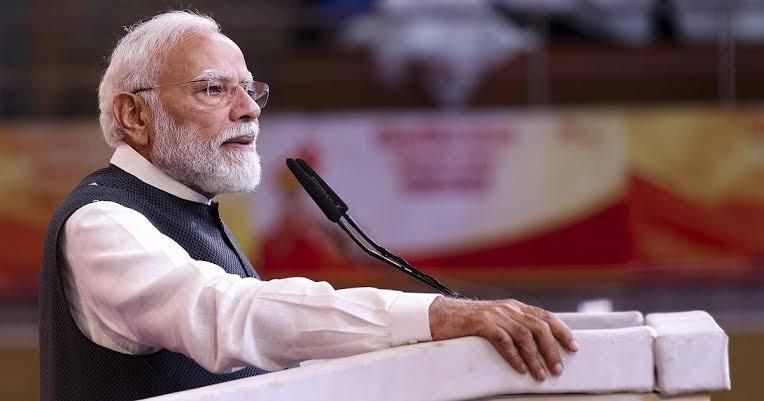
Prime Minister Narendra Modi has outlined an ambitious roadmap for India’s energy transition, announcing plans to add another 500 gigawatts (GW) of non-fossil fuel-based electricity generation capacity over the next 10 to 11 years.
Addressing the Bharat Renewable Energy Summit and Expo 2026 in New Delhi on Monday, the Prime Minister said India was steadily strengthening its position in the global renewable energy sector, with nearly 300 GW of non-fossil installed power capacity already achieved.
Highlighting the country’s progress in clean energy, Modi said more than 50 per cent of India’s total installed electricity capacity now comes from non-fossil sources, marking the achievement of its international climate commitment five years ahead of the 2030 deadline.
He described the proposed addition of another 500 GW as a challenging but achievable objective, expressing confidence in India’s technological capabilities, investment potential and growing renewable energy infrastructure.
The Prime Minister also projected investment opportunities exceeding ₹20 lakh crore, equivalent to approximately USD 220 billion, in India’s clean energy ecosystem by the end of this decade.
The proposed investment expansion is expected to cover renewable power generation, electricity transmission networks, domestic manufacturing, battery storage and emerging green energy technologies.
Referring to the ongoing international energy uncertainties, particularly developments in West Asia, Modi emphasised that energy independence has become closely linked with the country’s economic stability and long-term security.
He said India’s sustained investment in renewable energy during the past decade had helped the country withstand external energy-related disruptions more effectively.
According to the Prime Minister, excessive dependence on conventional fossil fuels leaves economies vulnerable to international conflicts, supply-chain disruptions and fluctuations in global energy markets. He stressed that renewable sources provide an opportunity to build a more diversified and sustainable energy system.
Modi said India had attracted investments of more than ₹15 lakh crore in the renewable energy sector over the last ten years. Since the 2024 RE-INVEST Summit, approximately ₹6 lakh crore has additionally flowed into the sector over two years.
Inviting domestic and international investors, he said India’s policy continuity, expanding energy market and growing industrial requirements provide considerable opportunities for businesses operating in the renewable energy domain.
The Prime Minister also stressed the need to expand rooftop solar installations and connect public infrastructure with clean electricity systems.
He called for government offices, educational institutions, colleges, hospitals and street-lighting infrastructure to increasingly shift towards solar power. He also underlined the importance of developing indigenous battery technologies and strengthening domestic energy-storage capabilities.
On green hydrogen, Modi highlighted the National Green Hydrogen Mission, which aims to establish an annual production capacity of 50 lakh tonnes, positioning India as an emerging player in the global hydrogen economy.
He further emphasised the importance of the Green Energy Corridor, an interstate transmission network designed to facilitate the movement of electricity generated through renewable energy projects.
The second phase of the Green Energy Corridor has been supported with an allocation of ₹2 lakh crore, aimed at strengthening transmission infrastructure and integrating additional renewable power capacity into the national grid.
Highlighting the practical benefits of solar adoption, Modi said more than 44,000 government buildings had already been connected to solar energy systems, generating annual savings estimated at around ₹700 crore.
The Bharat Renewable Energy Summit and Expo 2026 was inaugurated by the Prime Minister on November 2 and will continue until November 5.
The four-day international event is expected to bring together representatives from more than 130 countries, including over 40 ministers, policymakers, investors, financial institutions and leading industry stakeholders.
Several countries and international partners, including Australia, Denmark, France, Germany, the Netherlands, Norway, Sweden and the United Kingdom, are participating in the summit.
The event is also being organised alongside the 9th Session of the International Solar Alliance Assembly and the 4th International Conference on Green Hydrogen.
The latest announcement signals India’s intention to accelerate its transition towards cleaner energy sources while reducing dependence on imported conventional fuels and strengthening long-term energy security.